Search Results
12 Rules for Life
Rule 1: Stand up straight with your shoulders back
Life has its hardships. Learn to do what is best for yourself, even when it is hard. You do it because it's best; don't do things because of desire first, but for how they benefit you.
Rule 2: Treat yourself like someone you are responsible for helping
You must find out what you want then strive for it. Think of the future for your goals and aspirations.
Rule 3: Make friends with people who want what's best for you
Your friends shouldn't insult you, be cynics, or envy your success. Have ones that strive for improvement for both themselves and you. Don't have ones that put you down for your failures continually but ones that lift you up when times are hard.
Rule 4: Compare yourself to who you were yesterday, not to others
Always try to end each day just a little better, with slightly better habits, peace, knowledge, etc. Don't let your inner cynic voice cause you doubt.
Rule 5: Do not let your children do anything that makes you dislike them
Complacency with children breeds bad things. Learn to be able to discipline them to preclude bad behaviours. Don't let your kids control you or you will create a monster.
Rule 6: Set your house in perfect order before you criticize the world
Stop doing the things you know to be wrong now. Before you go out judging the world, judge and repair yourself.
Rule 7: Pursue what is meaningful (not what is expedient)
Do what is meaningful and right. Not what is expedient. Think about what you do, is it truly the correct thing to do? Could you not be doing something more optimally aimed at your goals? Think.
Rule 8: Tell the truth - or, at least, don't lie
Don't lie, it is the act of satan himself to do so, it creates doubt and is malign by nature. If you must not tell the whole truth just think about whether it is absolutely necessary. Speak the truth.
Rule 9: Assume that the person you are listening to might know something you don't
Try to truly understand what others have to say. One good method is to summarise their point (or your interpretation of it) when they are done. This will help you in understanding and if you are wrong, they correct you and you understand more.
Rule 10: Be precise in your speech
Articulate yourself. Especially in relationships the other side should understand your arguments and emotions just as you do theirs. You can't solve a problem between yourselves if you don't know what the problem is.
Rule 11: Do not bother children when they are skateboarding
Be strong. Don't be a purely agreeable wimp; life is hard and you must stand up when it is needed. Be steadfast and be strong to thrive through hardship.
Rule 12: Pet a cat when you encounter one on the street
Try new things, don't be afraid to step outside your 'group' or 'homeostasis' and do something new. Pet that dog and cat that walk by, walk up to the person you like the look of, say that someone looks great when they do. Don't be afraid by inner limitations of your mind.
48 Laws of Power
Law 1: Never outshine the master
Do not let them feel insecure due to your outshining them. Protect their ego.
Law 2: Never put too much trust in friends, learn how to use enemies
They will be your most loyal if befriended. Beware of too much trust in friends.
Law 3: Conceal your intentions
Smoke screens, gaslighting, emotively speaking as if you believe one thing but actually believe another.
Law 4: Always say less than necessary
Say less, lowers chance of saying foolish things.
Law 5: So much depends on reputation - guard it with your life
Reputation is all. Guard it above all else. Destroy others' to gain big advantage.
Law 6: Court attention at all cost
You must be noticed to be remembered thus to matter.
Law 7: Get others to do the work for you, but always take the credit
Just because you take credit doesn't mean you must do the work. Profit off others. Always take credit.
Law 8: Make other people come to you - use bait if necessary
Make others come to you, it'll make them feel more in control making easier manipulation. Bait them by using anger and "private inside knowledge".
Law 9: Win through your actions, never through argument
Actions speak louder than words. No one can argue with an act. But with words they will. Can also use words to mask true actions. Demonstrate not explicate.
Law 10: Infection: Avoid the unhappy and unlucky
Avoid the unfortunate and associate with the fortunate. Never associate with people that share your defects. If you are too introverted, associate with the more extroverted. Learn to see peoples' defects through their past. Do not die of others' misery.
Law 11: Learn to keep people dependent on you
Make others dependant on you. Whether by your council, knowing their secrets etc. Give a man a fish don't teach him to catch it and he'll be dependant on you.
Law 12: Use selective honesty and generosity to disarm your victim
Selectively be honest, kind, generous to disarm others. A sprinkle of honesty (maybe more) does a lot when trying to decieve and persuade.
Law 13: When asking for help, appeal to people's self-interest, never to their mercy or gratitude
When asking for something, point out how fulfilling your request serves the person in question. Find what makes the person tick, what they strive for/want and interlace it with your wants to make them fulfill them.
Law 14: Pose as a friend, work as a spy
Act as a friend but work as a spy drawing out info. Surround yourself with lies to mask your truth from others' spies. Learn to probe for valuable info e.g weaknesses while remaining friendly and inconspicuous.
Law 15: Crush your enemy totally
Destroy your enemy completely when victorious removing chance for revenge.
Law 16: Use absence to increase respect and honor
Make yourself and your skills saught after by making them scarce, works in seduction. Things are most appreciated when one is shown how life is without it.
Law 17: Keep others in suspended terror: cultivate an air of unpredictability
Unpredictability is key you can be known for your predictability but suddenly be different when it's important, keep people guessing about your next actions (when it's beneficial).
Law 18: Do not build fortresses to protect yourself - isolation is dangerous
Do not isolate yourself, isolation causes less info to flow to you and causes you to be more insignificant. Better to be shielded by the crowd than your fortress walls.
Law 19: Know who you're dealing with - do not offend the wrong person
There are 4 main types of people in this world:
- The insecure man: Hard to spot with fragile ego. If you realise you insult this person run as he holds grudges for long time.
- Suspicious man: Doesn't trust anyone. Use this to turn his suspicion against others.
- The man with long memory: When hurt won't show anger on surface but will wait for a position when he can get revenge. Calculative person shown by his calculation and cunning in different areas of life. Usually cold and unaffectionate. Crush completely or run if insult him.
- Unassuming, plain, often dumb man: Problem being that he may be too dumb to decieve so wastes time.
Never trust instincts in determining person. Observe and take mental notes.
Law 20: Do not commit to anyone
Never get attached to one side. Be the neutral one mediating as that's true control. Play all the sides against each other if you wish but not too much as they might realise.
Law 21: Play a sucker to catch a sucker - seem dumber than your mark
Almost always downplay your intelligence. Make victims feel smarter than you. They will never suspect you have ulterior motives.
Law 22: Use the surrender tactic: transform weakness into power
Never fight for honours sake. Surrendering gives time to regroup and make counterattack. Stay firm on inside but bend on outside.
Law 23: Concentrate your forces
Have one goal and be set to accomplish it. An arrow can't hit 2 targets at once. Only serve one master or view at once but don't tie yourself too strongly in case he falls (metaphor).
Law 24: Play the perfect courtier
- Avoid ostentation.
- Practice nonchalance (never seem too invested or working too hard).
- Be frugal with flattery before superiors get used to it.
- Be noticed but not too much so.
- Alter style and language based on person you are dealing with.
- Don't be bearer of bad news.
- Criticize only indirectly and subtly those above you.
- Don't often ask those above for favours.
- Don't ask favours on another persons behalf.
- Don't be cynical and negative constantly.
- Learn self reflection.
- Be the source to pleasure as much as possible. Avoid being source of displeasure no matter what.
Law 25: Re-create yourself
Do not accept roles society puts upon you. Be dramatic to be more popular using suspense. Adapt to temperaments of people close to you.
Law 26: Keep your hands clean
Have scapegoats for the bad you may have caused. Always try use a third party to do things that may damage your reputation if found out. Remember law 6. Sometimes you may admit to bad and seek forgiveness from those lesser than you but only do it for forgivable crime.
Law 27: Play on people's need to believe to create a cultlike following
Play to people's innate desires to believe in something. To make a cult good keep it vague and simple in premise but use strong words about bright goals of the group, keep it entertaining and find way to ward off cynics and skeptics, make it organised with ranks possibly through donations, disguise your income don't let followers know it's their money, make cult have enemy. This will keep it strong and connected.
Law 28: Enter action with boldness
Practice effrontery in everything. Whether it's negotiating, commanding, seducing etc. boldness is almost always better than timidity. You will find people trust you more if you seem to 100% believe in it.
Law 29: Plan all the way to the end
Have a plan at all times that takes into account risks possible, when you achieve what you desired stop and make a new plan that PLANS WHERE TO STOP. Never go further just off the rush of an earlier victory. Fail to plan plan to fail. Always take into account all risks. If it's risky don't do it.
Law 30: Make your accomplishments seem effortless
Make all tasks you do seem effortless. Hide the arduous process behind closed doors and make even the most difficult tasks seem a piece of cake. This will make you more sought after.
Law 31: Control the options: get others to play with the cards you deal
Give people options but only the ones you want them to. Gives them air of choice while being controlled. E.g Highlight the bad of not your choices, force a choice that's one sided, change circumstances to worse and worse over time squeezing decision out of the stubborn, use fear, led them into 2 choices both bad for them.
Law 32: Play to people's fantasies
Don't speak truth unless prepped for repercussion. "If you want your lies to be believed, don't tell the truth that won't be". Don't promise boring gradual improvement. Rather promise wealth and success fast and you will get followers. Fantasy is more appealing than reality, do not offer the obvious, offer the moon.
Law 33: Discover each man's thumbscrew
Find peoples weaknesses. Always seem openly interested this will spur to talk. Feed someone's childhood desire if known to win them. Weaknesses shown in opposite of trait someone shows when probed. Fill people's insecurities. People in grip of uncontrollable emotions like hatred, lust, greed, fear can be easily controlled using these. Find the weak link to get to person of interest or group. Plan ahead when doing this to not go too far.
Law 34: Be royal in your own fashion: act like a king to be treated like one
Act like a king to be treated as one. Don't swear. Make bold but not arrogant demands and don't waver. Choose highest opponent available. Give gifts to those above you; it equalises you with them. Separate yourself from others but not arrogantly.
Law 35: Master the art of timing
Master timing. Don't go asap as it creates many mistakes yet don't go too slow. Throw opponents off guard with changes of pace and time limits. When the correct conclusion comes, act on it quickly for it may come but once.
Law 36: Disdain things you cannot have: ignoring them is the best revenge
You choose to let things bother you. If the thing doesn't affect you much don't waste your time on it. Learn to show contempt for things not of great importance especially people's anger (only if not severe). Small and medium things just don't waste time on them but monitor their effect to not let get outta hand.
Law 37: Create compelling spectacles
Appeal to human senses especially sight. Big images and gestures may mask your true intentions to the people. Images are a powerful shortcut to power.
Law 38: Think as you like but behave like others
Blend in with the people, keep differing views to yourself and trustees. "Bene vixit qui bene latuit" - He lives well who conceals himself well. Don't correct people in convos you don't know how easily they offend.
Law 39: Stir up waters to catch fish
Keep a level, serene head but make others angry and emotional. Anger and emotion are very counterproductive to most things.
Law 40: Despise the free lunch
"Nothing is more costly than something given free of charge". When in some power give gifts to loosen people up. Make gifts out of the blue mostly. This softens the person in question. Learn to pay full price for things to avoid their hidden costs. Bait people with easy fast money for they are inheritly lazy.
- The Greedy: Cold, ruthless, see people as obstruction to wealth. Avoid or play greed to your gain.
- The Bargainer: Ignores time cost only cares ABT money cost. This is contagious so watch it.
- The Sadist: Avoid at all costs for they will try to swindle you. They believe paying you is excuse for torturing you.
- The Philanthropic Giver: Don't stay with them as their need for attention (reason for charity) will drain you too.
Law 41: Avoid stepping into a great man's shoes
You can't outdo your predecessor by doing the same thing as him for circumstances don't repeat exactly. Show visible improvement on predecessor but don't change for sake of change for it cause rebel. Watch out for young as they will be competition, can put in your shadow to minimise this.
Law 42: Strike the shepherd and the sheep will scatter
Target the person with the willpower. The one who truly is in control as everyone else will scatter once he is removed. Isolate the real perpetrator. Sometimes keeping someone in the group and know is better as to avoid revenge.
Law 43: Work on the hearts and minds of others
Force is always met with resistance. Earned loyalty is through their heart, emotions, and fears. Seduce by working on both emotions intellectual weaknesses. Focus on what distinguishes them and what they share with the people. Aim at primary emotions, push people to pain then give them pleasure when they expect it again to win them.
Law 44: Disarm and infuriate with the mirror effect
Mirror others' actions. This infuriates them if obvious. Learn to reflect people's innermost feelings desires and values and you will be loved by them. Reflect people's bad actions to make them see their error. See into a person through e.g their habits, friends, clothing, environment etc and mirror it where applicable. Beware to not follow in a failure's footsteps or you will be branded the same fate.
Law 45: Preach the need for change, but never reform too much at once
Always speak for change but don't enact it too swiftly. Slowly seduce Into people agreeing with you and never let an idea cloud your judgement. If a change must be expect fierce reactions and find ways to make it seem a less strong one, history may be slightly altered to suit your messages. One way to implement radical change is to vehemently support values of the past.
Law 46: Never appear too perfect
Never appear too perfect Ie downplay your successes. Your perfection causes envy in those around you that is only made worse by trying to help them.
Law 47: Do not go past the mark you aimed for; in victory, learn when to stop
Once you've reached desired outcome stop. You didn't plan further and nothing can substitute a good plan and strategy.
Law 48: Assume formlessness
Adapt continually to new events that come before you. Never take anything personally for its shows your opponents a way in, a way to exploit you through your defensiveness. Never Never Never let yourself become set in your ways for chances are there is a better way.
Agile Software Development
Page 1: Agile Principles (The "Agile Book")
*Transcribed from `WhatsApp Image 2025-12-30 at 22.18.50 (4).jpeg`*
1. Delivery and Communication
- Release new versions of the app as features are completed; don't wait for all features to be made before updating.
- Communicate very often and well; have "big picture" goals.
2. Adaptability
- ALWAYS adapt dev/app to changing Requirements (Req's).
- RED TAPE -> for devs no tape -> Let them propose new features.
-> Only propose to devs when idea is developed fully
3. Incremental Changes
- Make small changes often > BIG changes less often (make small iteration by iteration improvements that are pushed/deployed as they are made)
4. Business & Developer Collaboration
- Business people ALWAYS work with devs > 1/day (checkup).
- EVERYONE INVOLVED w/DEV.
- MEET often.
5. Motivation & Trust
- Motivate your devs & trust 'em.
- ~~Micromanage~~
- Understand the complexity of their work.
---
Page 2: Team Communication & Software Quality
6. Communication Frequency
- Communicate often and as much as possible, in person, with the team (daily if possible).
7. Working Software
- Working software = primary progress count.
- Never release buggy software unless as Alpha/Beta.
- Working software > deadline.
8. Sustainable Pace
- Trust the team to find problems with dev on their own at da start.
- Motivate to keep on during slow times.
- Sustainable Pace > Overworked but fast result .
- Remove unnecessary processes .
9. Efficiency & Quality
- Always strive to improve efficiency and to address QUALITY PROBLEMS whenever devs recommend.
- ++ dev access to efficiency-improving tools .
10. Simplicity
- Keep it as simple as possible.
- Some processes can, and should be skipped .
- The team should decide what is/isn't necessary .
---
Page 3: Problem Solving & Team Roles
Problem Reflection
- If a problem arises:
- Should we make `x` a habit?
- Can we automate something?
11. Self-Organization
- LET TEAMS SELF-ORGANISE
Step in only when required (and during meets)
12. Reflective Meetings
- Host periodic, reflective, team meetings after each sprint: lessons learned, mistakes/successes made.
Team Role Translation Diagram
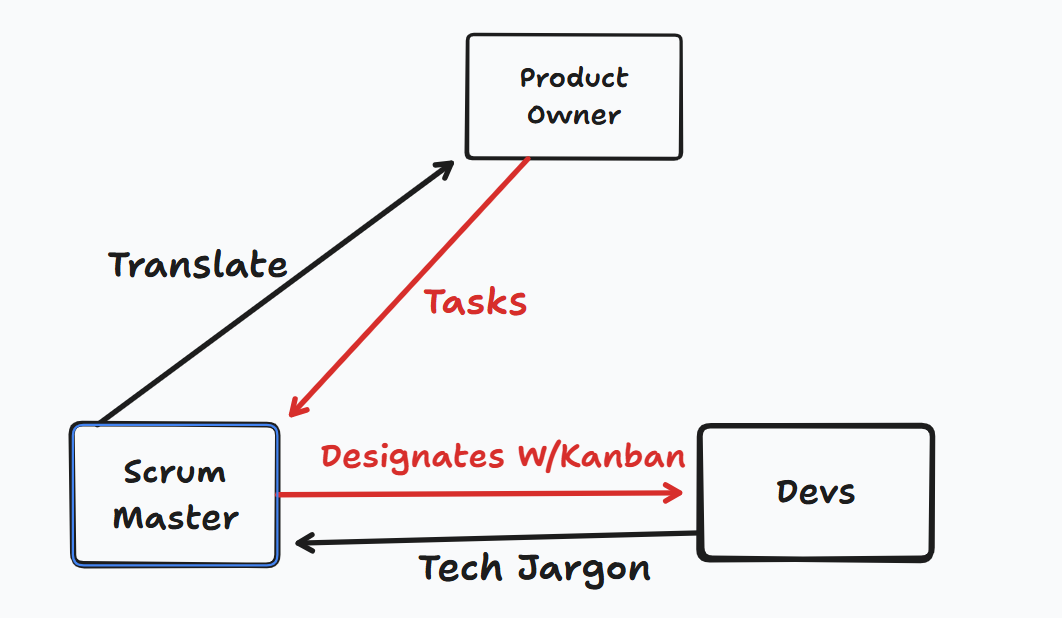
- Product Owner <--(Translate Tasks)-- Scrum Master --(Designate Kanban / Tech Jargon)--> Coder/Dev
Creative Dev Conflict Resolution / Problem Solving (CIDI Acronym)
- C: Get to the root of the problem.
- I: Brainstorm solution ideas.
- D: Don't shut down any ideas, work them together.
- I: Implement fix ... checkup & repeat until solved.
Leadership Style
- Coach & facilitate conversation for conflict, don't direct.
---
Page 4: Sprint Structure
*Transcribed from `WhatsApp Image 2025-12-30 at 22.18.50 (1).jpeg`*
The Sprint Cycle Diagram:
- Sprint Planning -> (Down to)
- Mid-sprint checkup (review) -> (Up to)
- Sprint Review (at end) -> (up to)
- Sprint reflection -> (Back to start)
Phase Details:
1. Sprint Planning
- 1 sprint ≈ 1 feature.
- Meet for < 2 hours.
- Product manager discusses: goals (with high-level perspective) and potential problems.
- Assess the future of the project.
2 & 3. Mid/End-sprint Checkup (Review)
- Review current progress: Problems/pains? Show work?
- UPDATE status of sprint: tasks done / tasks not done.
- Collaborate .
4. Sprint Reflection
- Negative feedback: reflect, improve, where can efficiency improve?
- Gather insight:
- What would dev change?
- What GOOD?
- What BAD?
- New CHALLENGE / PROBLEM / TOOL found
Footer:
- KEEP SPRINT BACKLOG
---
Page 5: Sprint Events & Management
*Transcribed from `WhatsApp Image 2025-12-30 at 22.18.50.jpeg`*
Sprint Event Do's & Don'ts
Do:
- Yes but... -> Yes and...
- Plan meetings; keep them fun and adaptable.
- Motivate participation; follow the meeting format.
Don't:
- Blame people
- let emotions fester (express them instead).
- Invite random guests without approval
- fight.
Core Definitions:
- Backlog: Comprehensive list of tasks that need to be done to build the app.
- Deadline: "How much time will it take you?" not "do this by this deadline"
- Kanban/Accountability:
- If assigned Kanban work is [not done], ask why.
- Positive Praise and Encourage Questions `[Green]`.
- Create a culture of accountability.
Meeting Timeline Features:
- Summary of last sprint review.
- Plan & tasklist for this sprint -> Kanban making & allocation.
- Questions & clarification; new problems/skills/found tools.
Knowledge Database:
- Make a database/Kanban of project problems/tools/skills.
- Allows All PPL to know who's good at what/who solved what and find tool info.
Atomic Habits
1. Cue (Make it Obvious)
- Make new thing you want to do have an obvious cue (e.g. if you want to learn piano put it on desk).
- Implementation Intention: Write out: "I will (behaviour) at (time) in (location)."
- Habit Stacking: "After (current habit) I will (new habit)."
- Make the above sentences have no ambiguity to when and where.
- Remove cues of bad habits from environment.
2. Craving (Make it Attractive)
- Habit Stacking + Temptation Bundling: "After (Current habit), I will (habit I need). After (habit I need) I will (habit I want)."
- Highlight benefits of avoiding bad habits to make them seem more unattractive.
- Consistently do something you enjoy immediately before a difficult new habit to make it attractive.
- Join a community where your desired habit is normal and where you already have things in common.
3. Response (Make it Easy)
- Start new habit by making it <2mins (Two Minute Rule).
- Slowly ramp it up.
- Slowly ramp down bad habits.
- Most effective learning is PRACTICE, not planning.
4. Reward (Make it Satisfying)
- Track your habits. When you miss a day it's fine. But never miss twice or more.
- Punish yourself if you fail a habit or fail to stop a bad one.
- Identity: Make your habit change part of your identity (e.g. "The goal is not to read a book but to become a reader").
- Habits Scorecard: Score all your habits (+, -, =) based on whether they're good, bad, or neutral to who you wish to be.
Wisdom & Quotes
- When preparation becomes procrastination, STOP.
- Greatest threat to success is boredom, not failure.
- Reflect and review on habits and acts to see where to improve.
- Big enough WHY solves any HOW.
- Aristotle: "Youth is easily deceived because it is quick to hope."
Discipline Equals Freedom
Core Rules & Definition
- Question Everything ALWAYS: Don't understand a word? concept? function? thought? Question it. Ask yourself constantly: Who am I? What did I learn? Is this what I should be doing? Is this all I got?
- Discipline IS: Waking up early, doing what must be done, NEVER STOPPING until the job is done, disciplining emotions, eating right, working out hard, facing stepping into fears and discomfort while LOVING IT.
- THERE IS NO WEAKNESS.
- No Compromise EVER on: Working & training hard, constantly improving myself, cleaning up, not giving in, maintaining self-discipline.
- LIES: "It's not your fault / It's okay"... "You can rest now"... LIES NEVER LISTEN.
Action & Hesitation
- NEVER HESITATE: That feeling when you wanna do something but aren't doing it? (e.g. talking to someone). JUST GO!: don't wait, hesitation deepens as soon as you start.
- EVERY DAY IS A MONDAY: NO REST. No more excuses, "I'll start tomorrow", giving in, bowing to unproductive / bad thoughts, waiting for perfect moment. Indecision, lies, weakness. Only when I am who I wanted to be / what, then I say no more & rest.
- Vigilance: Just like your build / grow, you deteriorate stop-by-step you must be vigilant: one late wakeup here, one cheat snack / skipped workout there will start it. Never let go, always get back on track.
- Just GO!: Don't think, plan, make excuses, JUST GO! Afraid? GO! Wanna run a marathon? JUST GO! You can, you just need to want it badly enough.
Mental Toughness
- The Darkness: The darkness always loses unless you let it. KEEP YOUR WILL, KEEP YOUR DETERMINATION, NEVER GIVE IN.
- Negative People: Ignore and outperform them. While they're complaining, you're getting ahead. If needs be, be professional and ask for feedback on what u doing wrong.
- GET UP OUT OF COMFORT: Laugh at the shit and good alike. To spite the suffering, challenges, suffering loneliness, laugh at it all, they can't stand it, laugh at the screaming, laugh at it all.
- GET UP: Even when you won't / not have enough time. Prepare your day, make a routine. NEVER STEP OFF THE PATH, then you might give up. As you use your will, it strengthens.
Diet & Physicality
- SUGAR IS THE ENEMY.
- Allowed Foods: Meat, fish, lacto-fermented dairy & cream, eggs, nuts, fungi, veg & small amount fruit.
- Okay: Pickles, pork rinds, butter.
- Fasting: If no right foods are available, just starve / fast, it's healthy. STILL DRINK WATER / TEA / COFFEE.
- STRETCH DAILY: Kneeling hip flexor, swimmer, cossack, hip external rotation, sleeper, couch, downward dog, cow face pose, high wall.
- Injured/Sick? Just do what you can unless very sick, don't use it as an excuse to do nothing. Try still do something e.g. walk, stretch, sit ups, push ups, etc.
Greatest Salesman in the World
The Vows & Habits
- Today I begin a new life. I will not be dragged down by my unnecessary knowledge or my useless experience. I will form good habits and become their slave.
- Things change fast; books will only be useful in principle with time.
- Subconscious takes over once you repeat enough.
- Bad habits I will break however difficult this act will be. Any act repeated becomes a habit and thus easier. I will make an oath that nothing will slow my new life's growth.
Love & Greeting
- I will greet this day with love in my heart. I will welcome happiness for it opens my heart yet I will endure sadness for it opens my soul.
- I will love all for they have qualities to be admired even though they may be hidden.
- When I meet a person, any person, I will silently say "I love you" to them.
Persistence
- I will persist until I succeed. I am a lion and I refuse to walk, talk, or sleep with the sheep. I will not hear the complaints of them. Their disease is contagious. Let them join the sheep without me.
- I will always continue, even in small steps towards my goals. No matter how small the step, I will take it, always.
- Vocabulary: Remove "quit", "cannot", "unable", "improbable", "impossible", "out of the question", "failure", "workable", "hopeless", "retreat".
- I will remember that by chance, however many times I fail is however many times closer to success. This is a lottery in part, I have the odds stacked in my favor.
- I will resist always my body's pull to give up, like David Goggins does. If I succeed, I will keep on, the grind never stops.
Uniqueness
- I am unique and I will take advantage of it. I will focus on being unique, not on imitating others.
Live for Today
- I will live this day as if it is my last.
- I will forget and worry not of yesterday as I can't change it.
- I will forget tomorrow as I live today not then.
- Some don't get to live today, I do, I won't waste it.
- Procrastination -> Action. Doubt -> Faith. Fear -> Confidence.
- Laziness I will run from, idle hands I'm from, idle speech I cover my ears from, idle bodies I run from. Being idle steals a day from you and others.
Mastery of Emotions
- I will master emotions through positive action.
- Transmutations:
- Sad -> Laugh
- Ill -> Double my labour
- Fear -> Plunge ahead
- Inferior -> Wear new garments
- Uncertain -> Raise my voice
- Poverty -> Think of wealth to come
- Incompetent -> Remember past success
- Insignificant -> Remember my goals
- Overconfident -> Recall failures
- Overindulge -> Think of past hungers
- Complacent -> Remember my competition
- Enjoy moments of greatness -> Remember moments of shame
- All powerful -> I'll try to stop the wind
- Attain great wealth -> Remember one unfed mouth
- Overly proud -> Remember moments of weakness
- Feel skill is unmatched -> Look at the stars
Laughter
- I will laugh at the world. I will stop taking things so seriously.
- THIS TOO SHALL PASS.
- I will laugh, I will sing, I will act, I will art. I will be too busy for sadness.
- I will never be so serious that I don't laugh.
Goals & Action
- I will make goals for day, week, month, year, lifetime.
- When making goals, I'll take past experience and X100, aim for the stars, maybe hit a planet on the way.
- I will stumble often on my path to success, this is expected.
- Today, I will multiply my value a hundredfold. I WILL ANNOUNCE MY GOALS.
- I will never stop, stay hard.
- I WILL ACT NOW. (Repeat constantly).
- I will never push tasks for tomorrow for I know that tomorrow never comes. Better to act and fail than to be useless.
Prayer
- I will pray for guidance from god yet I will never pray for anything other than how to achieve, ie I will not pray for material goods.
- Guide me in my words that they may bear fruit yet Silence me from gossip that none be maligned.
- Discipline me in the habit of trying again and again yet help me make use of law of averages.
- Bless me with alertness that I may see opportunity and gather patience to achieve opportunity.
- Overwhelm me in good habits that the bad ones may drown yet help me to understand weakness in others.
Maximum Achievement
Mental Laws & Attitude
- Listen to yourself and your inner voice above all else.
- Just walk away if control is highly improbable and changing the situation isn't worth it.
- Everything you are or will ever be will be as a result of the way you think. Be constantly positive in thought, no exceptions.
- Law of Expectation: ALWAYS EXPECT CONFIDENTLY AND CONSTANTLY THE BEST FROM OTHERS. Be inverse paranoid (believe the universe is conspiring something good for you).
- Sow a thought -> act -> habit -> character -> destiny.
- Performance Formula: (Inborn attributes + acquired attributes) x attitude = Individual Human Performance.
Self Concept & Esteem
- Learn to think of yourself not as you are but as you want to be. Envision a clear "self ideal".
- You can change your self image thus improve your life performance by deliberately changing mental pictures of yourself.
- 2 Rules of Self Esteem:
- You can never like or love anyone more than you do yourself.
- Never expect anyone to love you more than you love yourself.
- Repeat "I like myself" every day non-stop until it goes into your subconscious.
Criticism & Fear
- 7 Tips for Constructive Criticism:
- Protect individuals self esteem at all costs.
- Focus on the future not the past.
- Focus on behaviour of the performance.
- Replace word 'you' with description of the problem.
- Use 'I' to retain ownership of your feelings.
- Get clear agreement on what is to change. Be specific, future orientated and goal oriented.
- Assume other person wants to do a good job and they made a non deliberate mistake.
- Fear: Fear of failure and rejection is learned. Move towards dreams as if failure is impossible.
- Comfort Zone: Your body always tries to bring you back to where you were before if you try to change. Beware of old habits holding you back.
Goal Achievement
- Desired Outcome Method:
- Verbalise and affirm your desired outcome.
- Visualise clearly.
- Emotionalise (feel it solved).
- Release/let go of the situation completely.
- Realisation (appearance of solution).
- Goal Achievement Steps:
- Desire (Know what you want).
- Belief (Believe that you can).
- Write it down.
- Determine benefits.
- Analyse starting point.
- Set deadline.
- Identify obstacles.
- Identify additional info/people required.
- Make a plan.
- Visualise.
- Persist.
- Balance Goals: Family, Physical, Mental, Personal Development, Career, Financial, Spiritual.
- Major Goal: Pick a Major Goal that will help achieve the others.
Subconscious & Relaxation
- Self Relaxation/Hypnosis: 6 parts (L-Arm, R-Arm, L-Leg, R-Leg, Chest, Head). Repeat "is becoming heavy and warm" x6, "is now heavy and warm" x6, "is now completely heavy and warm" x6.
- Superconscious Mind Steps:
- Define problem clearly.
- Gather info.
- Consciously try to solve.
- If not -> Let go.
- Get conscious mind busy elsewhere.
- Schedule 1h of perfect stillness/silence daily. Let mind wander.
Relationships & Life
- Responsibility: Responsibility=Control=Freedom. Stop blaming. Say "I am responsible".
- Forgiveness: Make a list of everyone who hurt you. Say "I forgive him/her for everything, I now let it go".
- Relationships: Both parties need desired time to speak. Commitment must be 100%. Act your way back into the feeling of love if it fades.
- Children: Love them 100%. Criticism leads to condemnation; Fairness leads to justice; Approval leads to liking self. Hug/Kiss min 12 times daily.
Pre-Suasion
Questioning & Focus
- Word questions appropriately: E.g. for positive result ask "how much do you like this product?" vs "how much do you like or dislike?".
- Distance: By closing the distance between target and audience (e.g speak quietly so that people lean in) you increase their focus on the target.
- Focus: Consumers are more likely to choose the option they are focused on. Make them look at one real product and discourage comparison.
- Mystery: Mystery causes more popularity; someone with questions is usually more interested.
Language & Perception
- Harmful Language: Words like 'target' or 'beat' cause more aggression than 'goal' and 'outpace'.
- Ease: Easy to say = more likable (e.g. medicine names, stocks).
- Stereotypes: Subtly reminding people of a stereotype will make them perform better/worse based on it.
- Gratitude: Write down things you're grateful for daily.
Trust & Influence
- Likeability: Make customer like you. Compliments and flattery are effective.
- Trustworthiness: Most desirable trait. Don't be perceived as a 'waffler'.
- Disadvantages: Showing disadvantages (e.g. VW Beetle not pretty but reliable) can build trust and increase sales.
- Consistency: Remind someone of how they made a choice before.
- Unity: People feel strong bonds through family, blood, birthplace, religion. People with 'togetherness' help each other.
- Idea Acceptance: Find way to tacitly cause them to come up with the item; people agree with their own ideas more.
Remember Everything You Read
Speed Reading Methods
Method 1 (Textbooks)
- Read for 1 min. Mark spot where stopped w/ underlining hand motion.
- Read for 50s to spot marked w/ underlining hand motion.
- Read for 40s to spot marked w/ S hand motion.
- Read for 30s to spot marked w/ S hand motion.
- Read for 20s to spot marked w/ question mark motion.
- Read for 10s to spot marked w/ question mark motion.
- Read then at normal speed from spot marked for 1 min.
- *Note:* Try for heavily increased times (e.g 10x) for fun and for better results.
Method 2
- Read one min underlining hand motion (school text), note wpm, mark.
- Read one min underlining hand motion faster pace, move mark.
- Read one min S hand motion with increased pace, move mark.
- Count pages from start to last marker, double amount and place new marker there then read to it in 1 min.
- Add pages equal to dist from start to first marker.
- Read to third mark in 1min from start.
Comp Method (Class Text)
- Question mark hand motion ~4sec/page for 1 min. Then close book and recall for 1 min w/ recall pattern.
- S hand motion ASAP from start point of preview for 1min. Close book recall 1m adding to existing recall pattern.
- S hand motion 1m30s slightly slower pace allowing absorption of more detail, keep pushing speed to limit but allow more comp. Close Book recall 1min adding to existing recall pattern.
- S pattern 2min with pace allowing for required details for study purposes. Close book recall pattern 1min. Note reading speed in this step as it's the full comp one.
Rich Dad Poor Dad
Wealth Principles
- Innovate: Do something new, if what u do now isn't making you rich then do new thing.
- Education: Read books and learn new and unique things for business ideas. Learn a lot through books, podcasts, seminars etc.
- Networking: Find people who've done the specific thing u want to do and socialise with them ask for tips. Need talk to a lot of people and make a lot of offers, negotiations, etc.
- Action: Make lots of offers even those unlikely to work. Action > Inaction.
- Market Awareness: Be in a certain area periodically for a long time. The change you see or don't see may be exploited.
- Buying: Profits are made in buying not selling, shop for money making deals in all markets not just yours. Look for buyers then look for sellers and take small commission?
- Scale: Think big. Small scale makes small money.
- Learning: Learn from past companies, people, etc. Learn from their mistakes.
Speed Reading
Purpose & Prep
- Make a list of all the books/book types you've read and find purpose to reading each.
- Challenge: For next 30 days do the same with books that you are planning to read. Remember: ALL BOOKS.
- Always have motivation for what you read (i.e. why you read it).
- Before starting to read a book scan through main headings, contents table, etc to find out main things the book covers.
Peripheral Vision Improvement Methods
1. Shultz Table
(Standard exercise for expanding vision).
2. Bold Letter Focus
Focus on a bold letter (e.g. B) in the center and read/identify surrounding letters with peripheral vision.
3. Sticks and Straw
Get straw, focus on center, put toothpicks/sticks simultaneously into straw while looking at the center of the straw.
4. Ball Bounce
Bounce ball off wall at a spot just above eye level and try catch. When too good at it try make it go out of even peripheral so that from peripheral info you have to estimate where it's going to be.
5. Object Observation
Stare at random object and note things in peripheral vision e.g look at bin note the buildings, road signs and their text, people, etc.
6. Line Drill
Draw a line through center of page and while concentrating on that line try read all words on either side with only peripheral vision.
7. Column Drill
Make columns and rows of letters and while focusing on middle column number/letter, try notice all others on either side on the same row.
Retention
- The mind forgets over 80% of what it reads within an hour.
- Circumvention: Train your mind by attempting to recall e.g the last chapter or last page etc that you read all from memory, no notes.
Eye Exercises
- Extremes: With eyes only look as far as possible left and right holding extremes for 1 second each. Do 10 times.
- Circles: Do circles with eyes as wide as possible. 5 times per direction.
- Figure 8s: Do figure 8 each direction 5 times.
- Plus Sign: Do plus sign going back to centre after every line. e.g look left then centre then right then centre etc. 5 times full plus.
- Scrunch: Scrunch all face muscles then open mouth and eyes wide as possible 5 times holding 3s per form.
- Blinking: Close eyes for half second then reopen while sitting in chair 10 times.
- Massage: Gently massage closed eyes doing circles 10 each direction. Also massage eyebrow area and below eye.
Surrounded by Idiots
The Four Types
Red (Dominant)
- Traits: Ambitious, goal driven, extremely competitive, seek Control. Blunt and direct ("Do what I ask as quickly as possible"). Adaptive.
- Body Language: Powerful handshake, eye contact, controlling gestures, lean forward when unsure.
- How to Deal: Speed up tempo, cut small talk, be concise. Don't let them walk over you. Show you work hard. Point out risks.
- Criticism: Use strong examples, stick to facts, appeal to ego, make them repeat main points.
- Stress: Take away control/results. Tell them to "calm down".
Yellow (Influential)
- Traits: Nonchalant, always positive, creative, persuasive. Talk about themselves a lot. Many friends/parties.
- Body Language: Friendly, shaking hands, close proximity.
- How to Deal: Work when happy, strip away minutia, emphasize new/innovation. Flattery works. Coordinate appointments properly (tell them earlier time).
- Criticism: Strictly keep to agenda, give concrete examples, treat with assurances of friendship.
- Stress: Ignoring them, being negative/skeptical. Schedule them.
Green (Stable)
- Traits: Genuinely caring, reliable, listening, indecisive, conflict-averse ("Better safe than sorry"). Avoids change and responsibility.
- Body Language: Friendly eye contact, relaxed, lean backwards when unsure.
- How to Deal: Slow down, explain plans in detail, provide security. You must do the planning. Be patient with change (small steps).
- Criticism: Private only, reinforce friendship, tell them specific things to do (don't ask them to solve it).
- Stress: New tasks without description, unfinished tasks, quick decisions.
Blue (Analytical)
- Traits: Perfectionist, organized, realistic, logical, cautious. Needs concrete evidence. "Trip more important than destination".
- Body Language: Little to no body language, keep others at distance.
- How to Deal: Stick to task, checklists, no daydreams/stories. Be meticulous and prepared. Stick to facts.
- Criticism: Specific detailed examples in writing. Stick to hard facts. Be ready for in-depth questions.
- Stress: Unexplained decisions, uncalculated risks, emotional people. Give alone time.
The 4-Hour Body
Diet Guidelines
- Fruits: One day a week no more.
- Allowed Foods:
- Legumes: Beans (pinto, kidney, black beans, etc.)
- Vegetables: Peas, lettuce, broccoli, cauliflower, asparagus, green beans, spinach.
- Proteins: Chicken breast, beef, pork, fish, eggs.
- Rules:
- NO WHITE FOOD: No white bread, rice of any kind, cereal. Or anything that can be white.
- No oats or whole grains either.
- Don't over-vary meals (increases chance of quitting). Eat the same few meals over and over.
Cheat Day
- Take a day off diet a week (probably Saturday).
- Eat whatever you want with zero limits at all. This actually helps metabolism.
Drinks
- No drinking anything other than water, black tea/coffee.
- Use cinnamon instead of sweetening agents.
- Almost no milk/cream.
- NO FRUIT JUICE OR SODA.
Strategies & Supplements
- Recording: Record progress of things you want to record. Note down cravings during the week to eat on feast day.
- Supplements:
- Potassium (Avocados, spinach, lentils, fish).
- Magnesium (MagneB6).
- Calcium (Agar).
- Seasoning: Allowed to season food. Small amount of sweeteners/butter is fine.
- Oils: Macadamia oil is recommended.
Troubleshooting
- If plateauing:
- Too little protein?
- Eating too late?
- Drinking too little water?
The 30 in 30 Rule
- Eat protein within 30m of waking up.
- MINIMUM 20G PROTEIN PER MEAL NO EXCEPTIONS.
- Aim for 30g minimum for breakfast.
Hydration
- Drink minimum 1.5L water/day.
- Min 2.2L on cheat day.
Misc
- Warning: Don't overeat on nuts and chickpeas (healthy but ultra calorie dense).
- Cinnamon: Eat >4g/day (close to it). Good for fat loss/blood sugar.
The Art of Seduction
Seductive Characters
- The Siren: Physically seductive, breathy tone, ornate clothing.
- The Rake: Master of words, aggressive hunt, incorrigible reputation.
- The Ideal Lover: Finds the weak spot / thing target never had. Keeps up image of idealism.
- The Dandy: Plays with limits/expectations. Gender ambiguous. Lives for pleasure.
- The Natural: Keeps childhood traits. No limits, playful, innocent but impish.
- The Coquette: Delayed rewards. Self-sufficient, makes target chase. Narcissistic.
- The Charmer: Compliments and pleasure. Focuses on target's ego. Validates pain.
- The Charismatic: Immense confidence/energy. Diving figures (Lenin, Rasputin).
- The Star: Feeds desire to escape. Vague, reveals bits of private life.
Victim Types
- Reformed Rake/Siren: Give illusion their ways still work on you.
- Dreamers: Identified by books/films. Use illusion of their dreams.
- Spoiled: Bored easily. Need distractions and mystery.
- New Prude: Obsessed with appearance. Reveal a naughty side.
- Crushed Star: Wants attention. Give them the spotlight.
- Novice: Curious innocence. Seduce with corruption tint.
- Exotic Fetishist: Seduce by being different/exotic.
- Drama Queen: Victim complex. Give them things to bicker about.
- Professor: Lord mental superiority. Let them feel stronger.
- Beauty: Validate parts no one else does (intellect/personality).
- Baby: Turns all to play. Be the adult for them.
- Rescuer: Wants to help. Act like you can't deal with life.
- Roué: Older/experienced. Seduce by looking young/innocent.
- Worshipper: Needs to devote. Seduce by mirroring their desire.
- Sensualist: Overactive senses. Aim for senses (colors/smells).
- Lonely Leader: Suspicious. Be blunt and at their level.
The Process
- Indirect: Gradual encounters.
- Mixed Signals: Go against expectations.
- Desirability: Appear desirable (surround with others).
- Create Need: Emphasise sadness/anxiety about current life.
- Insinuation: Bold statements followed by apologies.
- Mirror: Mirror target's emotions/values.
- Temptation: Analyse desires (dirty/repressed). Create hard-to-resist temptation.
- Spontaneity: Be unpredictable.
- Language: Use vague yet seductive language. Eloquent vocabulary.
- Detail: Small gifts/shows are decisive.
- Halo: Keep a fantastical image.
- Isolate: Push through doubts with bravery.
- Mix Feelings: Flip from positive to negative to strengthen bond.
- Physicality: Use physical contact (eye contact, glances).
- Close: Swoop in with effrontery when desire is shown.
Anti-Seducers (What NOT to do)
- Self centered / Narcissistic.
- Large ego / only talking about yourself.
- Lack of generosity / Stinginess.
- Quarrelsome / constant complaining / nagging.
- Smelling or looking bad.
- No filter (demeaning comments in public).
- Proffessing love too quickly.
The Elements of Pizza
Dough Stats
- Hydration: Inversely proportional to oven temp (Temp up = Hydration down).
- Order: Water -> Salt -> Yeast -> Flour.
- Temps: Water 32-35c. Dough 27c after mix.
- Kneading: Knead 30s after 20m rest.
- Weights:
- Neopolitan: 260-285g.
- Roman: 150g.
- Bar: 190g.
Technique
- Shaping:
- Stretch 1/3, fold back. Rotate.
- Cup hands with pinky on dough/counter. Pull 5 inches to tighten.
- Sauce: Pulse max 3 times (don't make watery).
Thinking Fast and Slow
System 1 & Heuristics
- Cognitive Ease: Make things easy to understand (low brain power). Bright colors, high contrast.
- First Impressions: People make near instant judgements.
- Anchoring: Exaggerated questions lead to skewed estimates (e.g. "Was Gandhi older than 144?").
- Loss Aversion: People focus on loss. "90% fat free" better than "10% fat".
- Sunk Cost Fallacy: Throwing good money after bad.
- Certainty Effect: 99% to 100% is perceived as a massive jump compared to 95 to 96.
Tribe of Mentors
Advice & Mindset
- Advice: Give a different way to THINK, not exactly how you did it.
- Trust: Trust the work. Don't let others knock you off course.
- Risks: Take risks now. Failure is the point.
- No: Learn to say NO. Don't always agree.
- Fear: Run towards fear. Get out of comfort zone.
- Freedom: Discipline is the path to freedom.
- Reinvention: Reinvent yourself. School knowledge becomes irrelevant by 40.
- Simplicity: "What would this look like if it was easy?"
Tactics
- Business: Find something that isn't extremely popular so that you can contribute considerably. Don't be afraid to pay a bit to learn a lot.
- Focus: Write distracting ideas on notepad while studying, then plow on. Max 30m work / 15m break.
- Stress: Affirm it's natural, be curious, feel it strongly. Don't push down.
- Meditation: Vipassanna (feel breath/body without control).
- Tennis: Focus on where the racquet hits the ball and not ball's destination.